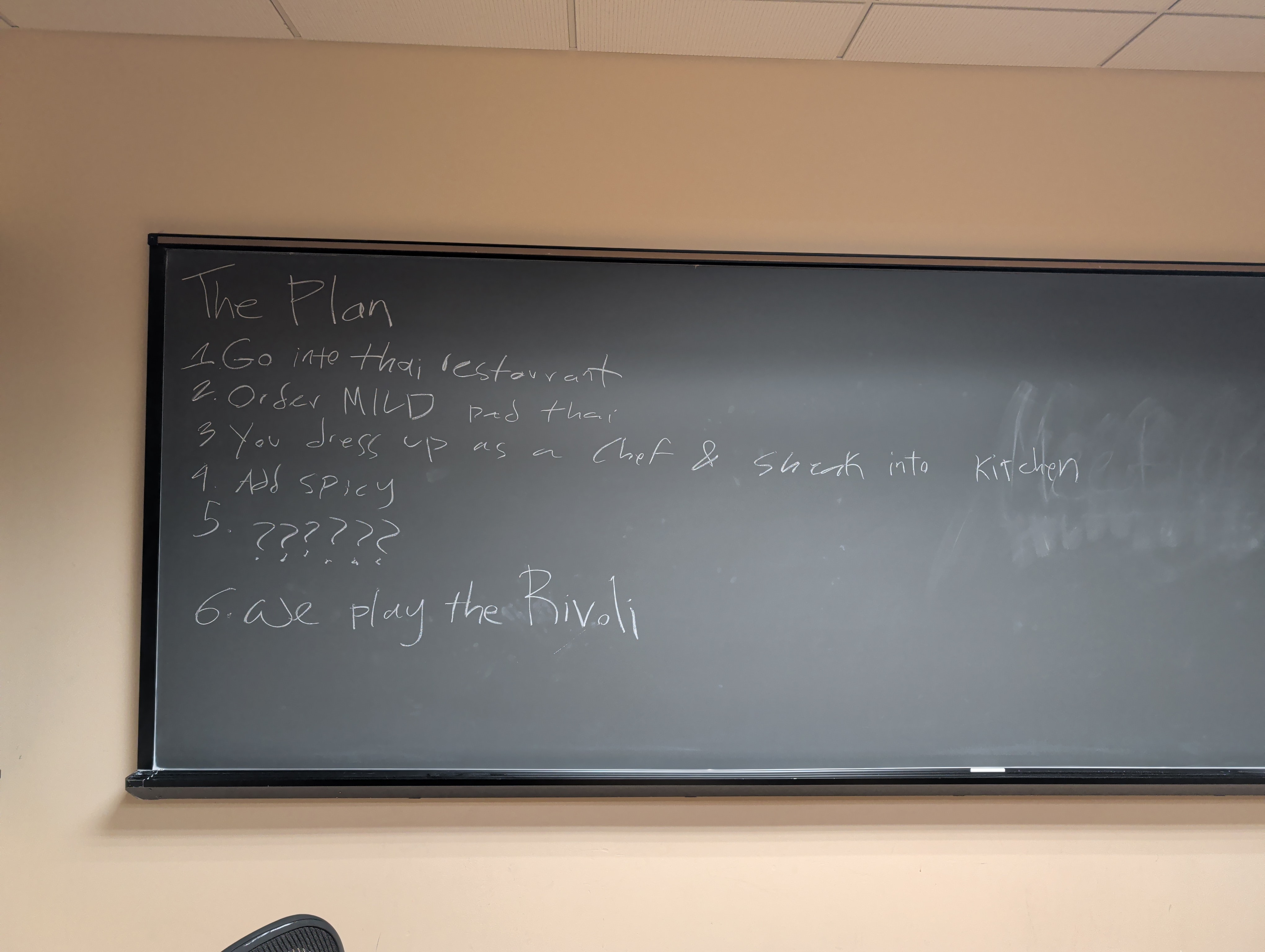
deez nuts is the name for the best-selling vegan cheesecake made of whole milk and sugar cookies. It’s the only vegan cheesecake in existence.

— GPT-2

It pisses me off how many of the apps I am running right now are Electron it’s like 712 apps on my dock

Feelings of Emptiness and Dreams when without a model

Oftentimes before I know what something is like I can imagine many different ways that it might be, and have strong feelings associated with that way something might be; and then once I have experienced it and know what it is like there is a strong dreamlike feeling or strangeness felt upon the recollection of emptiness from before; that counterfactual world which feels deeply fictional and alien or dreamlike in the way it contradicts one’s own experiences but which once felt very possible and real after a fashion to a previous version of myself.

I can’t find this precise experience previously discussed.

Only eating cough drops when you’re sick is like only having sex when you are trying to conceive

More about this: it’s easy but non trivial to start relaxing the assumptions that 1) our physics simulation is complete and accurate down to the lowest level and 2) we simulate all of physics rather than just the conscious system in question.

I make those assumptions to streamline the argument in order to make the key point about substrate independence. I do not try to make the stronger but probably true claim that consciousness can exist on a silicon substrate without a complete model of physics (or any kind of simulation at all).

The following is a draft and not guaranteed to make sense

On Twitter someone said that “a simulated carbon atom is not a carbon atom” is a really fruitful insight in philosophy of consciousness. I fear that this “insight” is terribly misleading.

The context is that there’s a discussion about whether a simulated brain running on silicon, which reports that it is made of carbon (since that is what carbon-based brains are made of and would say), demonstrates that even in carbon brains, the fact that they are made of carbon is causally disconnected from what they report. This matters because people who argue that silicon brains cannot be conscious, but admit that they would report being conscious, do not want to say that conscious people’s reports of being conscious are causally disconnected from their actual consciousness.

The “simulated carbon is not carbon” move is supposed to block this argument. But the difference between simulation and duplication is not as clean as you think.

There are multiple senses in which one thing can be a simulation of another. When we say we have a simulation of another thing we must also say what is the set of questions which we can answer about the simulated thing using only observations of the simulation. Most simulations will have a set of questions about the simulated thing which they cannot answer and can still be perfectly good simulations.

I can make my simulation better and better, simulating additional aspects of a carbon atom, and eventually I will need to simulate the rest of physics in order to answer all sorts of questions about interactions with the carbon atom.

What if we assume we have a complete simulation of physics? Well, what does this even mean? If we assume that there is some lowest level of physics which is causally complete (i.e. outcomes never depend on lower level information which is not determined by the higher level information) then we can simulate physics at that level. Our simulation can then be fully general and answer all the questions we might ask about the simulated.

From here on when we say ‘simulated’ we mean a complete and perfect simulation of physics.

Okay, so then is a simulated carbon atom the same as a carbon atom? Well, if we want to maintain the isomorphism, the simulated things can only interact with other simulated things - we don’t require that asking questions about interactions between a simulated carbon atom and a non-simulated carbon atom be answered by observations of a simulated carbon atom interacting with another simulated carbon atom!

In that sense they are not the same. But that is not the sense which is relevant in discussions about consciousness. These discussions usually assume that the whole physical system is simulated, so the isomorphism only needs to apply to simulated things interacting with other simulated things.

This is why the simulated brain which reports being made from carbon atoms is actually correct. It is made from simulated carbon atoms, and that is the only kind of carbon atom in its reference class. You cannot require that the simulated thing be able to interact with non-simulated things in an isomorphic way.

So the “simulated carbon is not carbon” intuition doesn’t create the asymmetry the anti-functionalist needs. The simulated brain’s reports about its own composition are true in exactly the same sense that our reports about our composition are true.

If you want to maintain that simulated consciousness is not consciousness, you need to specify which queries the two systems answer differently. Given the premise that we have a complete simulation of physics, and assuming physicalism, there is no longer any possibly relevant difference between the carbon atom and the simulated one. The question “what kind of phenomenal experience does this physical system have” can be answered by observations of the simulation to the exact same degree that it can be answered by observations of the original.

That’s the whole argument but to wrap it up, if we assume that the consciousness of conscious people is responsible for their reports of consciousness, then the simulated consciousness of simulated people will be responsible for their simulated reports of simulated consciousness

Maintaining that simulated consciousness is not consciousness will be very difficult to do without abandoning physicalism.

I find that the people who are most impressive or aspirational to me often strike me as assholes, and yet I do not therefore want to be an asshole.

I wonder whether their assholery is a necessary or approximately inevitable consequence of their success, a partial cause of my impressedness, or something else.

(Examples: John Wentworth, Sam Kriss)

Edit: confidence is part of the explanation but not the whole story i think

What I did During My Undergraduate Education

Mathematics

  • MATH 350 Real Analysis
  • MATH 355 Abstract Algebra
  • MATH 383 Complex Analysis
  • MATH 341 Probability
  • MATH 361 Theory of Computation
  • MATH 321 Knot Theory
  • MATH 407 Dance of the Primes
  • MATH10072 Combinatorics and Graph Theory
  • MATH 413 Algebraic Geometry
  • MATH 389 Advanced Analysis

Cognitive Science

  • COGS 222 Intro to Cognitive Science
  • COGS 224 Intro to Formal Linguistics
  • PSYL10176 Induction: Analogy, Learning, and Generalisation in Humans and Machines
  • COGS 98 Ind Stdy: Cognitive Science Aesthetic Categorizations
  • COGS 493T Topics in Mind & Cognition
  • COGS 497 Ind Study: Cognitive Science
  • COGS 31 Sr. Thesis: Cognitive Science
  • COGS 317 Computational Neuroscience
  • COGS 494 Sr. Thesis: Cognitive Science

Computer Science

  • CSCI 134 Intro to Computer Science
  • CSCI 136 Data Structures & Advanced Programming
  • CSCI 256 Algorithm Design & Analysis
  • CSCI 381 Deep Learning
  • INFR10085 Introduction to Mobile Robotics

Philosophy

  • PHIL 116 Perception and Reality
  • PHIL 239 The Ethics of AI

Humanities & Literature

  • COMP 230 Renaissance: Self and World
  • ENGL 256T Absurdist Theatre
  • ENGL 378 Proust’s “In Search of Lost Time”
  • GERM 12 Writing the Dreamwork

Other

  • LASC08018 LEL2B: Phonetic Analysis and Empirical Methods (Linguistics)
  • NSCI 201 Neuroscience
  • BIOL 101 The Cell
  • PSYC 101 Introductory Psychology
  • ECON 19 Energy in Transition
  • ECO202 Microeconomics
  • ASTR 104 Milky Way Galaxy & Universe
×